
Virtual Twins Are Now Required to Stay Competitive | Are You Prepared for the Future?

To stay competitive in today’s landscape means you need to do more than just implement technology. You need to implement it intelligently and in a way that properly leverages it for a real advantage for your organization. These days, having a virtual twin is less of a recommendation and more of a requirement to stay ahead of the competition.
Not having a virtual twin could be costing you time, money, and your competitive edge, letting you fall short of goals and leaving performance on the table. Implementing a virtual twin for your organization allows you to visualize, simulate, and validate real-world systems with fewer risks than traditional, physical testing.
What is a Virtual Twin?
Virtual twins are fully digitized representations of the physical world. As a result, you have a true-to-life virtualization of all your systems, people, and procedures to help lower risks through virtual validation without needing a physical test.
Virtual twins rely heavily on a continuous feedback loop, meaning that it won’t be perfect the first time around, but gets more accurate and valuable as time goes on. As results from simulations and physical testing get more refined, so do virtual twins.
What Are the Benefits of Virtual Twins?
Implementing a virtual twin means that you can leverage the most elevated form of the concurrent engineering and design cycle. Traditional design cycles heavily rely on physical prototyping and validation, which increases cost and lead times when changes are required. The concurrent design cycle has prototyping and validation done virtually and at any moment, allowing your team to stay agile as changes occur.
Improved Business Resilience
With virtual twins, businesses experience increased collaboration and protection from risks.

With everyone on a single platform and the entire system visible to stakeholders, there is nowhere for communication to break down. Additionally, companies can run a near-infinite number of scenarios through validation and testing to protect themselves from future vulnerability.
Improved Productivity and Quality
With virtual twins, business experience accelerated product testing and engineering processes.
With the majority of validation done virtually, you no longer need to wait for a physical prototype or room on a testing machine to open. Your current processes can be over 30% faster with a virtual twin and give you more time to innovate on your current designs.
Improved Design Sustainability
With virtual twins, designs are more sustainable and reach breakthroughs in technology more often.

With the continuous concurrent design cycle, you are constantly getting valid feedback on every aspect of a design. As a result, your product development choices are coming with empirical data, tackling real challenges, and having a real-world impact.
Virtual Twin vs Digital Twin vs Digital Model
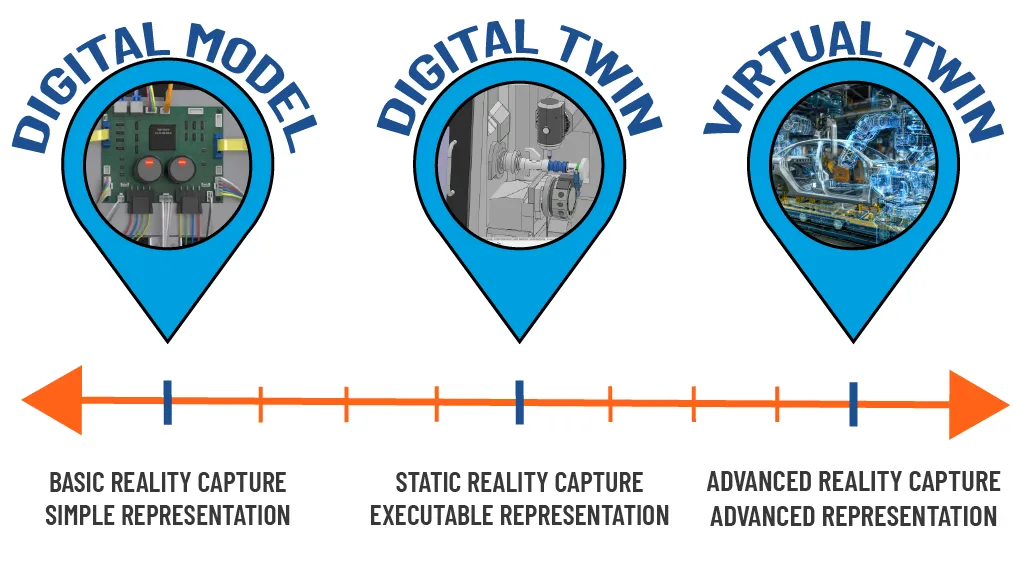
Virtual twins are ultimately on a spectrum that allows your organization to find a solution based on your current and future needs. We often see organizations fall somewhere between one of the following: digital model, digital twin, and virtual twin.
Digital Model
Digital models provide the simplest representation of your designed system and give a basic reality capture. SOLIDWORKS parts and assemblies give you the entry point with digital models, capturing engineering data to generate a virtual representation of the physical model.

With digital models, you can still make real-world impacting decisions and help drive innovation, just without all the data you could have with a full virtual twin. We see many organizations start here to build a CAD library, giving 3D models to sales teams, or letting consumers use their models for downstream applications.
Digital Twin
Digital twins are the first real entry to the virtual ecosystem that provides a digital representation needed for engineering execution, but are often a static reality capture. Running finite element analysis studies with SOLIDWORKS Simulation or programming robotic arms with 3DEXPERIENCE are typically where we see companies leverage digital models.

With digital twins, the design-altering designs come with a lot more data than just virtually testing part fitment or generating bills of materials. You’ll be able to gain insight from simple static studies to high-speed, dynamic impacts, as well as validating CNC toolpaths or shop floor layouts.
Virtual Twin
Virtual twins give the most advanced virtual representation of your physical world. These ultimately capture the model, system, and processes that make up your organization.

With virtual twins, you can validate real-world hardware by connecting it to the digital model or test form and fit through virtual reality applications.
Keys to Successfully Implementing a Virtual Twin
Aside from not utilizing a virtual twin at all, the biggest mistake your organization can make is jumping in without a plan. Without proper planning, you can find yourself with an underperforming virtual twin and potentially gain the wrong insight from your virtual world.
- Collaboration: Since a virtual twin takes all models, systems, and processes in your organization you need to work together to create a plan. Identify key stakeholders and clear, definable goals.
- Modeling: You can’t have a virtual twin without first having a digital model. Be sure to digitize everything you want included in the virtual twin, including small objects like bolts, specific materials used on components, and accurate spacing between manufacturing cells.
- Optimization: The best part of having virtual twins is getting to play with what-if scenarios. With no real risks, you can test some of the outlandish ideas you never could previously, to let you achieve real innovation.
- Performance: With the ability to test changes based on your wildest imagination, it’s hard to get caught up in those what-if scenarios. Be sure to efficiently make changes to your twins based on empirical data and stay true to the definable goals conceived earlier.
Are You Prepared for The New Era of Engineering Excellence?
Most companies find themselves leveraging a digital model at a minimum but ultimately land somewhere on the virtual twin spectrum. However, if your organization isn’t using some form of virtual or digital twin, the best way to do so is by switching to SOLIDWORKS.
No matter where you land on the virtual twin spectrum, TriMech is here to help you along your journey to engineering excellence. We have decades of experience helping clients along their digital transformation by leveraging our global expertise to find the perfect solution for you.
To speak to our experts to help you find your virtual twin solution, fill out the form here.

Related Service
Ready to learn more?
Whether you need expert guidance, product support, or simply explore your options, our team is here to help.